
Welcome
Happy Thursday and welcome.
Many of you have told me you enjoy the process-focused newsletters the most. If you’re one of them you’re in for a real treat today.
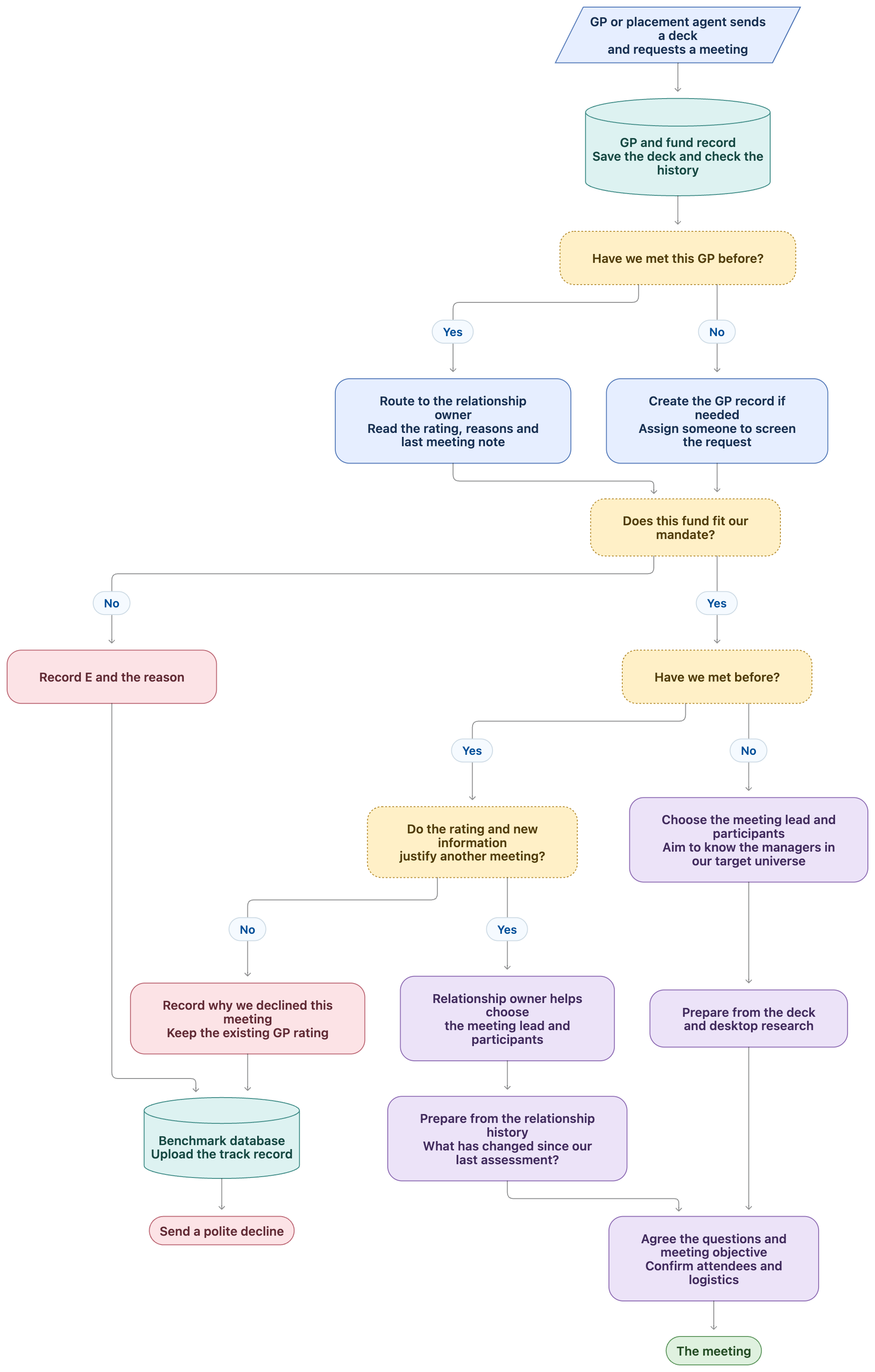
Today I will be using a flowchart to answer the simple question: "What happens when a GP or placement agent sends a deck and asks for a meeting?"
As an LP, I had this happen at least 50 times a year - probably more. It was never a fun exercise to figure out what to do, and includes surprisingly many steps to do it right.
In Founders Corner, I finally got myself a personal agent. And why I’m already loving it.
Steffen
Less admin. Better decisions. By LPs, for LPs
BeyondTVPI is about the process work of being an LP. FundFrame is built to support this. Learn more below.
THE MAIN STORY
The flowchart I never had as an LP
Lately, I've been making a lot of flowcharts internally. It has become very easy to do so with AI, and I find it great for communicating my thoughts to our developers, to clients and to anyone else who want to listen.
So, here's a flowchart for a very simple thing: A GP or placement agent sends a deck and asks for a meeting. This happened +50 times a year when I was an LP.
The problem is this simple request can set up a lot of work:
Have we met them before?
What do we already know about this manager?
Is it good enough to warrant a meeting?
In any organization, small or large, this sets of a chain of events with people emailing the team, asking for opinions, knocking on doors, etc.
That's what the process should fix. Whoever gets the request should be able to find your existing view and know what to do with it.
I've put it into a flowchart.
In practice, that means things like:
Rate the managers in your target universe. In my two prior firms, we wanted to know all of them, and our ratings guided how we spent our time. We basically always took meetings with A- and B-rated managers. And of course, those who fit our mandate that we hadn’t met before (who we rated U for Unknown).
Decide on repeat managers. If a C-rated manager came back after a year or two and nothing material had changed, we generally passed on another meeting. If it had been longer we generally took it.
Record your criteria. You need to know why they were a C to make that call. The reason you passed is exactly what the next person needs when that manager comes back.
Make the rating and the reason available to the whole team. If they live with a person, an inbox or someone's notes, you'll keep asking the same questions. A simple test: take the last five meeting requests you received. Could the person who got each one have found your view within five minutes?
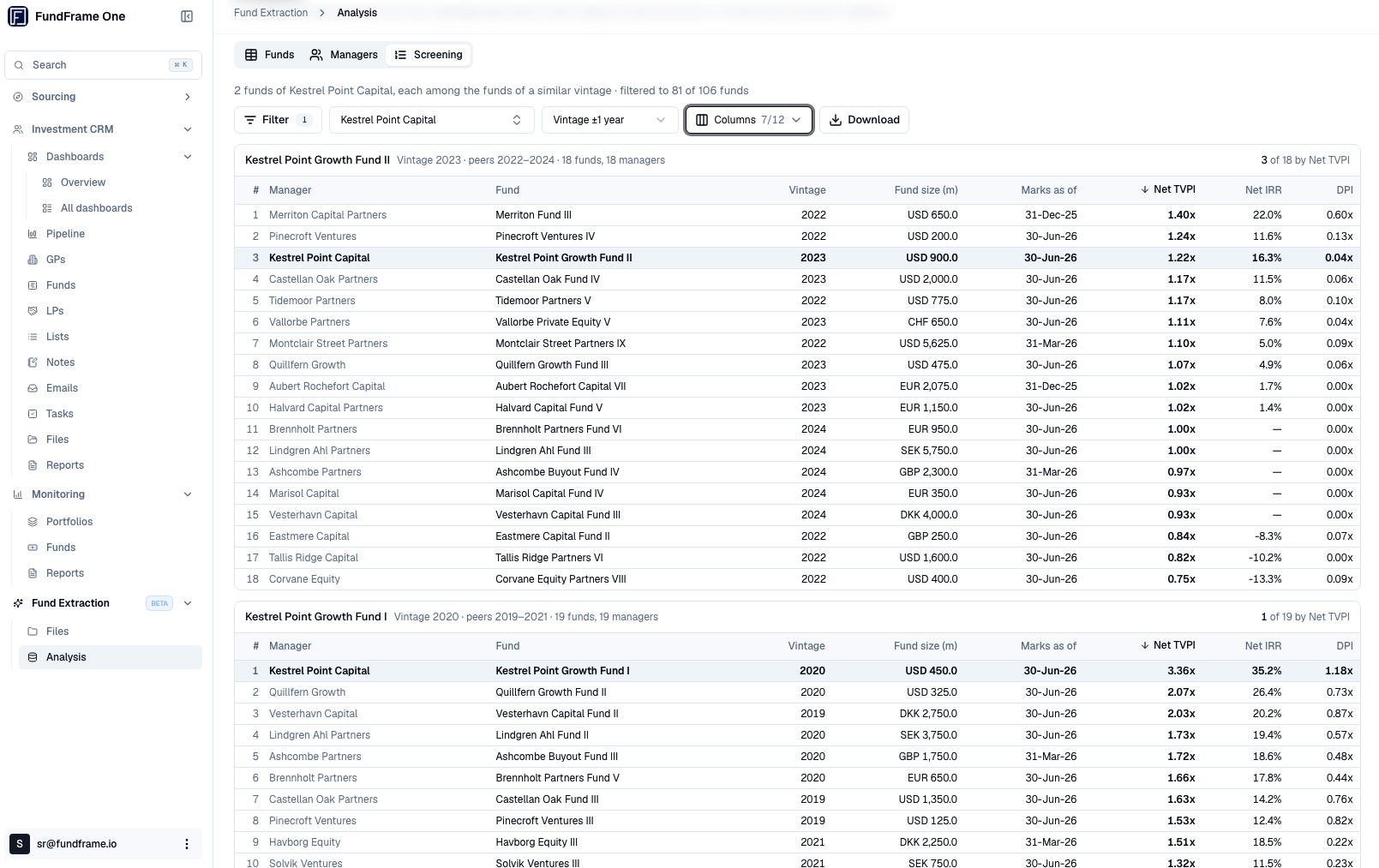
Get value from the deck even when you decline. Add the track record to your internal benchmark database, so every presentation builds your benchmark. In FundFrame, you upload the deck and the values are automatically extracted.
The other side: What would you think of a GP’s sourcing process if, every time a banker brought them a deal, they had to ask around the firm to find out whether anyone had met the company?
So, what’s left? What's left is judgement: the rating itself, the mandate, the meeting. The process doesn't make the call, and it never can. That’s where your value as an LP with judgement, experience and taste comes in.
At FundFrame we can help with the record, the history and benchmarking every deck you receive. But we can't do the thinking for you.
If your first reply to a GP meeting request is still an email to the entire team asking “Has anyone met these guys?”, the problem isn’t the deck.
The chore now suddenly had value
At my two firms working as an LP, we had good processes and systems for this. When a deck came in, it took me a few minutes to pull our history and judge whether the manager warranted a meeting. But it was still a chore just to say no, and it gave us nothing back.
Now, FundFrame subscribers can simply upload the deck to build their internal database.
The chore now suddenly had value.
Here's a fictional data set comparing "Kestrel Point" to other funds with similar vintages and sorted by net TVPI.
You can learn more about screening in FundFrame by clicking here.
FOUNDERS CORNER
One less thing to remember

Grok Bot
I finally got myself a personal agent with Grok. My favourite part is how it removes friction from my life.
As an example, most Saturday mornings I take my two-year-old son to rytmik, a music and movement session. We don’t go every week, and I need to buy a ticket when we do. Now I get a message from my Grok Bot on Thursday morning: “Do you want to buy the ticket?” If I reply yes, it buys it for me.
I don’t have to remember to book it. Nor do I have to open the website, find the right date or fill in my details. I just reply yes.
That’s one example. It’s already taking care of a lot of other little things I used to have to remember or do myself.
ABOUT THE AUTHOR

This newsletter is written by Steffen Risager, the founder of FundFrame, a platform for LPs to manage their private markets investments.
Before that, Steffen was CIO at Advantage Investment Partners, a Danish Fund-of-Funds.
Steffen has a decade of experience as an LP, and has made commitments totalling approx. $6bn across fund- and co-investments.